
Formulation in Biopharmaceutical Manufacturing
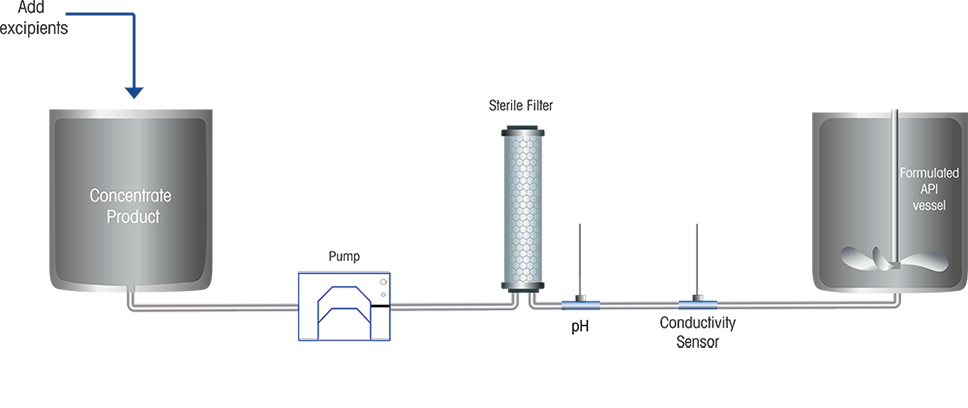
Formulation is a critical downstream bioprocessing step that adjusts parameters such as pH, conductivity, excipient concentration, and osmolality to stabilize biologic drug substances for storage, transport, and clinical administration. Proper formulation helps maintain structural integrity, potency, bioavailability, and compatibility with the final container-closure system.
Errors during formulation, such as incorrect buffer composition or improper excipient ratios, can lead to issues with:
- Drug product sterility
- Fill accuracy and dosing consistency
- Product stability and shelf life
- Batch release efficiency
- Regulatory compliance
- Patient safety
For GMP manufacturing, precise control and documentation of formulation parameters are essential for product quality, efficacy and compliance.
- Key Formulation Challenges
- pH Monitoring
- Conductivity Monitoring
- Reg. Alignment
- Benefits of Monitoring
- Summary
Biopharmaceutical manufacturers commonly face:
- pH drift during buffer preparation
- Incorrect excipient concentrations
- Conductivity variability between batches
- Delayed detection of formulation deviations
- Inconsistent manual sampling
- Limited process visibility
- Container-closure incompatibility
These issues can result in:
- Failed batches
- Costly rework
- Excess buffer usage
- Delayed release timelines
- Increased audit burden
- Leachables or absorption losses
Continuous in-line monitoring helps reduce variability, improve batch consistency, and support faster process decisions.
pH Monitoring
pH directly impacts:
- Protein stability
- Solubility
- Aggregation risk
- Drug product potency
Even minor pH variability can compromise product quality and long-term stability.
Benefits of In-Line pH Monitoring
- Real-time process visibility
- Faster corrective action
- Improved batch consistency
- Reduced operator intervention
- Enhanced GMP documentation
Conductivity verifies:
- Buffer composition
- Ionic strength
- Excipient concentration consistency
Benefits of In-Line Conductivity Monitoring
- Continuous buffer verification
- Reduced off-line testing
- Faster batch release
- Improved process control
- Better scale-up consistency
Formulation processes must align with global regulatory standards supporting product quality, patient safety, and process consistency.
Relevant Guidelines
- USP–NF and Ph. Eur. Monographs for excipient quality
- ICH Q1A(R2) for stability programs
- ICH Q8–Q10 for development and risk management
- EU GMP Annex 1 and 2
- USP <1237> and <659>
These frameworks require documented control of formulation parameters including:
- pH
- Conductivity
- Excipient concentration
- Osmolality
- Process monitoring data
Continuous monitoring of pH and conductivity enables real-time verification of critical formulation attributes during mixing and final preparation.
Key Benefits
- Early detection of process deviations
- Reduced batch variability
- Improved formulation consistency
- Reduced manual sampling
- Faster process decisions
- Enhanced data integrity
- Improved GMP readiness
Trend monitoring across batches also improves process understanding, enhances consistency, and supports continuous process verification.
| Critical Parameter | Why It Matters | Monitoring Technology | Best Practice / Mitigation |
|---|---|---|---|
| pH | Maintains stability and potency | In-line pH sensor | Validate buffer and excipient make-up: monitor during mixing. |
| Conductivity | Confirms buffer composition accuracy | In-line conductivity probe | Verify ionic strength against the target and adjust in-line if necessary. |
Integrated in-line monitoring technologies support more reliable, scalable, and data-driven biopharmaceutical manufacturing.
Discover how to streamline formulation verification with METTLER TOLEDO Pendotech in-line pH and conductivity monitoring systems to ensure every batch meets stability and excipient specifications.
Once formulation is finalized, the drug substance moves to sterile filtration for sterility assurance prior to filling.

 © Copyright 2026 Mettler-Toledo Pendotech