
Harvest Clarification in Biopharmaceutical Manufacturing
What Is Harvest Clarification?
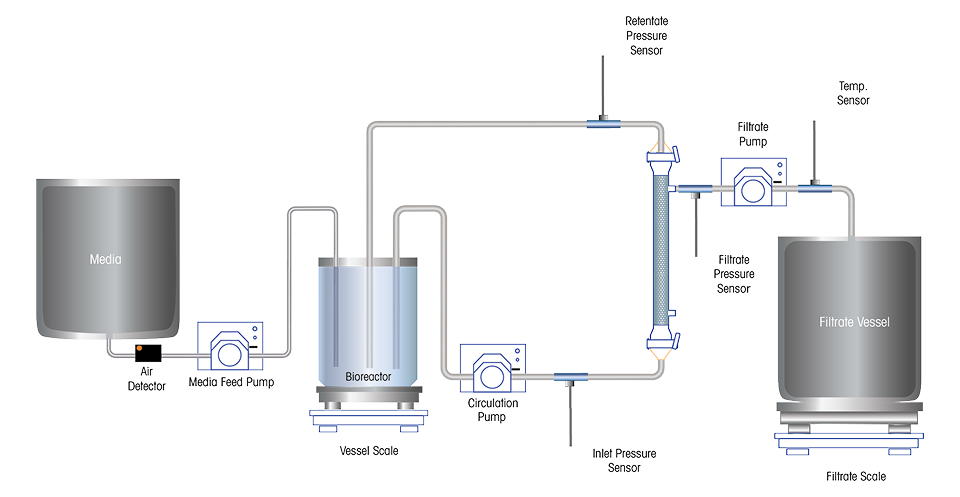
Harvest clarification is a critical downstream bioprocessing step that removes cells, debris, and particulates from harvested bioreactor fluid before chromatography and purification.
The goal is to protect downstream filtration systems and chromatography resins while maintaining product yield and process consistency.
In modern high-titer biopharmaceutical manufacturing, ineffective clarification can rapidly lead to:
- Depth filter fouling
- Increased differential pressure
- Reduced throughput
- Resin contamination
- Batch variability
- Longer processing times
- Increased manufacturing costs
Because clarification impacts downstream process performance, real-time monitoring of turbidity, pressure, and conductivity is essential for process control and regulatory compliance.
- Common Challenges
- Critical Process Parameters
- Benefits of Connected Monitoring
- GMP & regulatory Compliance
- Summary
Common Harvest Clarification Challenges
Modern biopharmaceutical clarification workflows face several operational challenges that can impact filtration efficiency and downstream performance.
High Solids Loading
High-cell-density cultures can rapidly foul depth filters, causing:
- Reduced filter capacity
- Increased pressure
- Frequent filter replacement
Batch-to-Batch Variability
Variations in upstream culture conditions may impact:
- Cell density
- Debris concentration
- Clarification consistency
- Throughput performance
Excessive Shear Stress
Aggressive pumping or centrifugation may:
- Damage sensitive proteins
- Reduce product recovery
- Affect biologic stability
Late Detection of Fouling
Without continuous monitoring, operators may miss early signs of:
- Filter blockage
- Turbidity breakthrough
- Process instability
- Downstream contamination risk
Key Monitoring Parameters in Harvest Clarification
Turbidity
In-line turbidity monitoring helps detect:
- Particulate breakthrough
- Incomplete clarification
- Changes in solids loading
- Process instability
Pressure
Differential pressure monitoring identifies:
- Filter fouling
- Flow restrictions
- Increasing process resistance
- Depth filter blockage
Conductivity
Conductivity monitoring helps verify:
- Buffer identity
- Buffer transitions
- Process consistency
- Cross-contamination prevention
Continuous monitoring improves process visibility, troubleshooting speed, and downstream protection.
Real-Time Process Visibility for Faster Decision-Making
Many facilities still monitor turbidity, pressure, conductivity, and flow separately, creating fragmented process visibility.
Connected monitoring systems improve:
- Early deviation detection
- Operator response time
- Filter utilization
- Batch consistency
- Troubleshooting efficiency
- Process scalability
Real-time monitoring helps operators:
- Detect fouling earlier
- Prevent downstream contamination
- Reduce manual intervention
- Protect chromatography resins
- Improve overall manufacturing efficiency
In harvest clarification, small shifts in turbidity or pressure are often the first indication of process instability.
Supporting GMP Compliance and Process Control
Harvest clarification processes must align with:
- FDA 21 CFR Part 211.113(b)
- EU GMP Annex 2
- PDA TR-26 guidance
- ISPE bioprocessing recommendations
Continuous in-line monitoring supports compliance by:
- Verifying particulate removal performance
- Supporting microbiological contamination control
- Enabling electronic batch records
- Improving audit readiness
- Supporting Process Analytical Technology (PAT) initiatives
Mettler-Toledo Pendotech solutions support:
- Single-use pressure monitoring
- In-line turbidity measurement
- Conductivity monitoring
- Connected downstream process visibility
- Real-time data collection and trending
Summary Table
| Critical Parameter | Why It Matters | Monitoring Technology | Best Practice / Mitigation |
|---|---|---|---|
| Turbidity | Detects particulate breakthrough to prevent downstream fouling | In-line, single-use turbidity sensor | Optimize pre-filtration and stage filters: monitor turbidity to indicate filter change before breakthrough. |
| Pressure | Reveals filter fouling/blockage in real time | In-line, single-use pressure sensor | Track differential pressure trends: swap filters proactively to prevent rupture. |
| Conductivity | Confirms buffer composition and flags contamination | In-line conductivity probe | Verify buffer conductivity before use: implement cross-contamination prevention SOPs. |
Explore METTLER TOLEDO Pendotech single-use turbidity, pressure, and conductivity sensors to support consistent harvest clarification, protect downstream chromatography, and maintain reliable compliance documentation.
Once harvest clarification is complete and contaminants are removed, the process moves into chromatography, where selective separation techniques isolate and purify the target molecule.

 © Copyright 2026 Mettler-Toledo Pendotech