
Chromatography for Biopharmaceutical Manufacturing
Chromatography is a critical downstream purification process in biopharmaceutical manufacturing used to isolate and purify monoclonal antibodies (mAbs), recombinant proteins, vaccines, peptides, plasmids, and viral vectors. Across capture, intermediate, and polishing steps, chromatography directly impacts product purity, yield, process efficiency, and GMP compliance.
Chromatography is also one of the most expensive downstream operations due to:
- High resin replacement costs
- Column qualification requirements
- Long process cycle times
- Product loss during breakthrough or elution
- CIP/SIP validation requirements
- Batch consistency expectations
For biologics manufacturers, CDMOs, and cell & gene therapy facilities, real-time chromatography monitoring helps maximize resin utilization, reduce deviation risk, and maintain validated operating conditions.
Critical Manufacturing Risks
Without continuous in-line monitoring, chromatography systems are vulnerable to:
- Product breakthrough and yield loss
- Resin fouling and reduced column lifespan
- Buffer preparation errors
- Flow instability and pressure excursions
- Aggregation during low-pH elution
- Batch inconsistency across manufacturing campaigns
- Increased deviation investigations and CAPAs
- Regulatory
- In-Line/On-Line Monitoring
- Capture Chromatography
- Intermediate Chromatography
- Polishing
- Summary
FDA, GMP, and ICH Compliance for Chromatography
Chromatography processes must comply with:
- FDA Process Validation Guidance (Stage 1–3)
- ICH Q8/Q9 requirements for operating ranges and risk-based controls
- GMP and 21 CFR Part 11 requirements
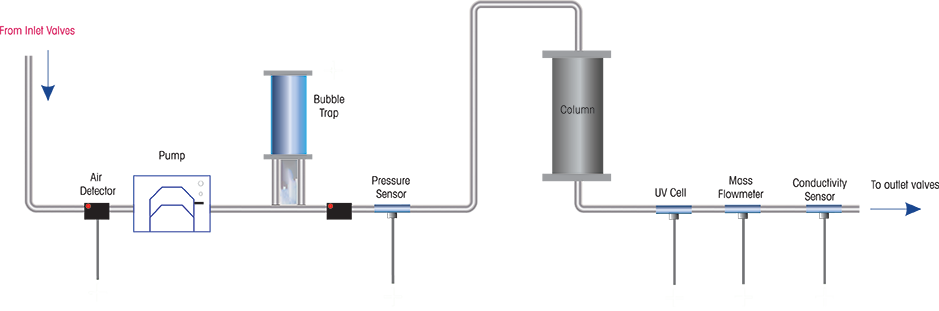
Continuous monitoring of UV absorbance, pH, conductivity, pressure, and flow helps ensure chromatography processes remain within validated operating ranges while supporting batch consistency and impurity clearance trends over multiple cycles.
Key Performance Indicators
- Product recovery yield
- Resin utilization efficiency
- Breakthrough detection
- Impurity clearance trends
- Pressure stability across cycles
Benefits of Continuous Monitoring
Improved Product Yield
Real-time UV and conductivity monitoring helps prevent premature breakthrough and product loss.
Extended Resin Lifespan
Pressure trend monitoring identifies fouling early, reducing unnecessary resin replacement costs.
Faster Batch Release
Automated process data supports faster review-by-exception workflows.
Reduced Contamination Risk
Single-use sensor technologies eliminate cleaning validation requirements and reduce cross-contamination risk.
Improved Process Consistency
Continuous monitoring helps maintain validated process conditions across campaigns and scales.
High-Capacity Product Isolation and Recovery
Capture chromatography is designed to isolate the target molecule from complex feed streams while removing bulk impurities such as host cell proteins, DNA, media components, and aggregates.
Typical applications include:
- Protein A chromatography
- Ion exchange chromatography
- Affinity chromatography
- Mixed-mode chromatography
Key Process Parameters
- UV Absorbance (280 nm) – Tracks protein loading and detects breakthrough events before product loss occurs.
- pH – Maintains optimal binding and elution conditions for sensitive biologics.
- Conductivity – Confirms buffer ionic strength and buffer exchange accuracy.
- Pressure and Flow – Detect resin fouling, column channeling, bed compression, filter blockage or packing inconsistencies.
Common Capture Chromatography Challenges
- Resin Fouling – Protein accumulation and contaminants reduce resin binding capacity and shorten resin life.
- Premature Breakthrough – Column overloading causes product loss and reduced recovery yield.
- Aggregation During Elution – Low-pH elution conditions can cause aggregation or damage sensitive molecules including:
– monoclonal antibodies
– fusion proteins
– viral vectors
Inconsistent Buffer Conditions
Incorrect conductivity or pH impacts binding efficiency and impurity clearance.
Impurity Reduction and Process Refinement
Intermediate chromatography steps further purify the target molecule by removing:
- host cell proteins
- DNA
- endotoxins
- aggregates
- leached Protein A
- process-related impurities
Monitoring Priorities
Critical monitoring parameters include:
- conductivity gradients
- buffer transitions
- pressure stability
- flow consistency
- UV peak resolution
Operational Challenges
Manufacturers commonly face:
- poor separation efficiency
- gradient inconsistencies
- resin degradation or fouling lowers resolution over time
- reduced impurity clearance over repeated cycles, leading to more offline testing
Continuous monitoring improves process reproducibility and impurity control.
Final Product Purification and Quality Assurance
Polishing chromatography provides the final purification stage before formulation and fill-finish.
Objectives
Polishing steps remove:
- trace impurities
- aggregates
- charge variants
- residual contaminants
while ensuring:
- product potency
- stability
- regulatory compliance
Key Monitoring Parameters
- UV absorbance
- pH stability
- conductivity precision
- low differential pressure
- consistent flow distribution
Common Risks
- subtle impurity carryover
- product dilution variability
- reduced separation efficiency
- final product specification failures
Real-time process analytics help maintain consistent final product quality and reduce batch rejection risk.
Summary table
| Critical Parameter | Why It Matters | Monitoring Technology | Best Practice / Mitigation |
|---|---|---|---|
| UV absorbance (280 nm) | Detects breakthrough and confirms load endpoint | In-line UV detector | Set load endpoint using UV breakthrough curve: avoid overloading resin. |
| pH | Ensures optimal binding/elution | In-line single-use pH sensor | Validate pH buffers: adjust in-line to maintain optimal binding/elution. |
| Conductivity | Verifies buffer identity/ionic strength | In-line conductivity probe | Check conductivity before column: correct deviations immediately. |
| Pressure / Flow | Reveals fouling or packing/channeling | In-line pressure and flow sensors | Monitor and control flow/pressure to prevent channeling: perform routine maintenance. |
Learn about METTLER TOLEDO Pendotech single-use, in-line UV, pH, conductivity, and pressure monitoring solutions that optimize chromatography performance, extend resin life, and deliver audit-ready data for downstream viral clearance.
After achieving high purification and removal of process-related impurities, the next critical step is viral clearance, a regulatory requirement to inactivate or remove potential viral contaminants and ensure patient safety.

 © Copyright 2026 Mettler-Toledo Pendotech